|
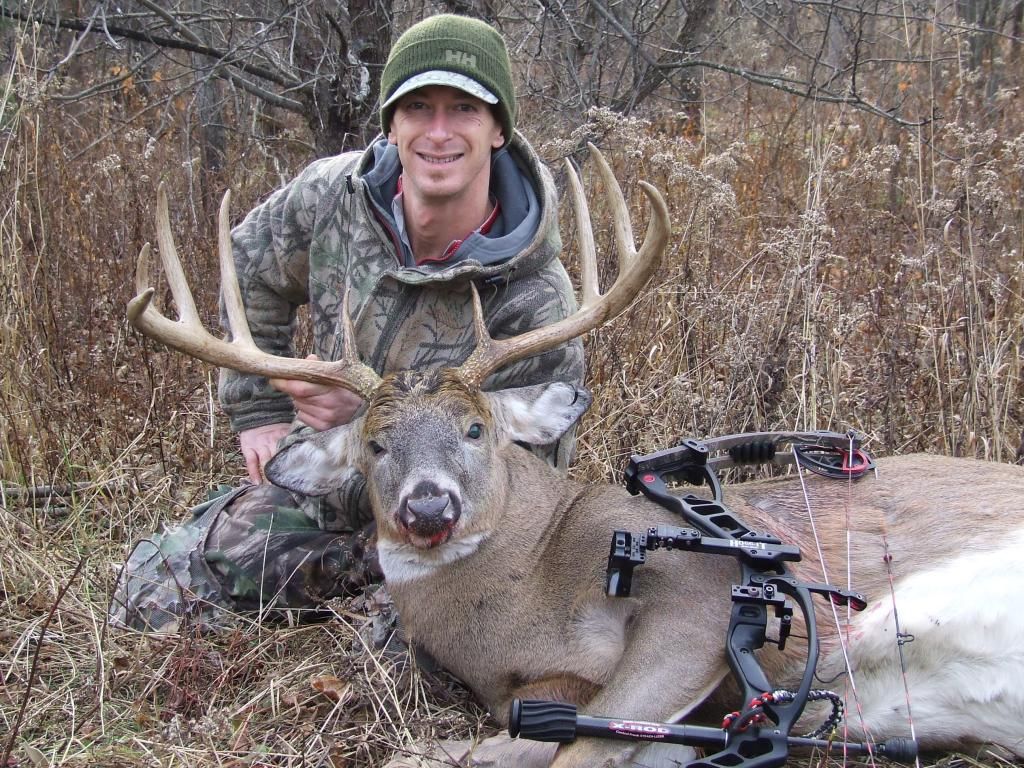
Le pourvoyeur ou je chasse la semaine prochaine émet des amendes de 350$$ a tout les chasseurs qui tirent 130 bc et moin...pour être sur qu'on évaluent bien les mâles il nous envoient ce textes..oui il est en anglais mais très facile a lire et tu peux le copier et le coller sur Google traduction et il va se transférer en français ..peut être qu'un membre ici pourrais même le reposter en français ..c'est utile a tous..
How to Score a Whitetail Deer in the Field
Characteristics to look for:
1. How many points does it have?
2. How long are the points?
3. How wide is it?
4. How long are the main beams?
5. Determining mass?
6. Body weight of the animal?
7. Adding it up!
1. How many points does it have?
The first seventy bucks in the Boone and Crockett record book all have more than eight points. It just stands to reason that the more points a buck has the better he is going to score. A buck that scores 120 inches as an eight pointer may score 130 to 135 inches as a ten pointer. Having good brow tines will also add greatly to the score. Having ten points won’t mean much if the brow tines are only an inch long, but if they are five inches long it’s going to make a huge difference in the score.
Also, make sure you get a good look at both sides of the bucks rack. I have seen this happen a number of times -- a hunter gets a look at a buck but only gets to see one side of the antlers and assumes that the other side matches the side he sees. After shooting the buck, the hunter is disappointed to find that the other side is broke off or is deformed for one reason or another. Don’t assume anything -- if you are serious about taking a trophy buck, wait until you see both sides!
2. How long are the points?
In order to determine this, one must have something to compare the length of the points too. The average whitetail buck has ears that are six and 1/2 to seven inches long. When viewing a buck, compare the length of the points to the length of the ear. This is the best way to get an idea how long the points are. If the buck has ten points that are short and stubby, he’s probably not going to score very well, unless he exhibits some other outstanding features such as long main beams or a lot of mass. Likewise, if the buck is only an eight point, but has long, G2’s and G3’s, he may score well.
Remember that brow tine length is very important, especially on an eight pointer. Having good brow tines is critical. I’ve seen some real nice eight points that didn’t make the minimum simply because they had short brow tines!
3. How wide is it?
This can be a hard one to judge, especially if you don’t see the buck from several different angles. Most mature whitetail bucks ears are going to be between 16” and 18” wide, tip to tip when their ears are on full alert. There isn’t any doubt about it when you see a buck that spread is way outside his ears, but I have been fooled a number of times when the buck’s ears are laid back. The spread on a 130-inch buck can looks pretty good with the ears relaxed. If you have time to evaluate the buck, it won’t take very long before you get a chance to see him with his ears alert. We like to tell our hunters that the spread should be out past the tips of the ears to help qualify him to meet our 130” minimum. Another viewing angle that helps determine width is looking at the buck from the front or from the rear.
4. Main beam length.
Main beam length is very important. There are several different things that need to be analyzed when deciding this. This measurement starts at the base of the antler and goes all of the way to the tip of the antler. When viewing the animal from the side, I try to see where the tip or end of the antler is in relation to the deer’s nose and eyes. If the end of the main beam isn’t at least out over the middle of the nose or further, I seriously start questioning the quality of the rack. Likewise, if the tip of the antler is out close to the end of the nose, the main beam length is probably going to be in the 22” to 25” length. Main beam length is also influenced by how wide the rack is and how much curve there is in the rack. The closer the tips of the antlers come together, the more length there is.
5. Determining Mass
There are several ways to get an idea of how much mass a set of antlers has on a live whitetail. Once again, the ears are used. If the antlers look spindly, compared to the buck’s ears, he doesn’t have a lot of mass. Likewise, if the antlers at the base appear to be close to the size of the ears, the mass is going to be great. Another thing to look at is comparing the bases of the antler to the eyes. If the bases are smaller than the eyes, there isn’t going to be a lot of mass. Likewise, if the bases are as big or bigger than the eyes, the mass is going to be good.
6. Body weight
You must take into consideration the average body size of the deer in the area you are hunting! There are a number of things you need to recognize when you are field-scoring whitetails. 140 inches of antler on a buck that weighs 130 lbs will appear to be huge. If you put that same set of antlers on a mid-west buck that weighs 250 lbs or more on the hoof, it won’t look nearly as impressive.
7. Adding it up!
To be a shooter, a buck should exhibit several strong characteristics of the items we have covered. Very seldom will you view a buck that is outstanding in all the categories. If you do, you will know it the second you see him and won’t even have to think about it.
If you see a buck, and you have to ask yourself if it is a shooter, the first thing you should look for is how many points he has and how long they are. Make sure you see both sides of the rack! Then I look at the length of the main beams. If they are out past the middle of his nose, and turn inward I know he has potential. The width of the rack is next on the list -- if the buck’s spread is out to or beyond the tips of his ears, that’s good enough.
As I stated earlier in the article, mass isn’t as important as the other qualifications but can make a difference on a border line set of antlers when scoring a whitetail deer.
Summary
Most of the time, when you see a buck that scores 140 inches or better, you are going to recognize it as a good deer. When a questionable deer shows up, and you have to question if the buck is going to make the minimum or not, you should take the time to evaluate the antlers using the guidelines I have listed above.
Tips
1) Good mass - about the diameter of the eye at the base.
2) Tall tines - high off the head
3) Good beam length - sweeping forward at or near the nose.
4) Good spread - a couple of inches outside the ears.
5) Number of points if I have time
An eye, at 1 1/2" diameter, equals a circumference of about 4 3/4", so if his bases are bigger than his eyes then his bases should be at least 5" or so.
I use ear tip to ear tip of 17", and an ear length of 8" for our area. Main beams out to the nose equals about 25" or so.
|



 Connexion
 Inscription
 FAQ
FAQ Rechercher