Pour Pierre Rainville.
Tu parles problableMinie ball
From Wikipedia, the free encyclopedia
Jump to: navigation, search
1855 minie ball design from Harpers Ferry, West Virginia.
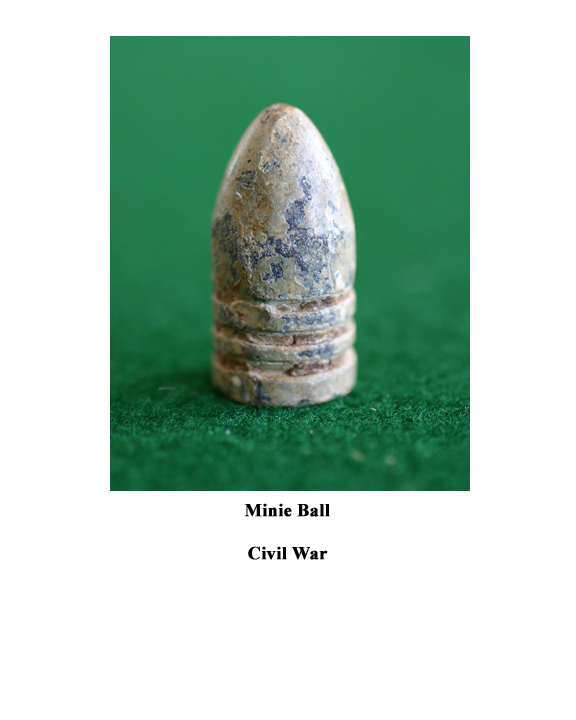
Various types of Minié balls. The four on the right are provided with Tamisier ball grooves for aerodynamical stability.The Minié ball (or minie ball) is a type of muzzle-loading rifle bullet named after co-developer, Claude-Étienne Minié, inventor of the Minié rifle. It came to prominence in the Crimean War and American Civil War.
Invented in the 1840s by the French Army captains Montgomery and Henri-Gustave Delvigne, it was designed to allow rapid muzzle loading of rifles, an innovation that brought about the widespread use of the rifle as a mass battlefield weapon. Delvigne had invented a ball that could expand upon ramming to fit the grooves of a rifle in 1826.[1] The design of the ball had been proposed in 1832 as the Cylindro-conoidal bullet by Captain John Norton,[2] but had not been adopted.
A countersunk ramrod was necessary to force the ball without damaging its shape.It was a conical-cylindrical soft lead bullet, slightly smaller than the intended firearm barrel's bore (see caliber), with (originally) four exterior grease-filled grooves and a conical hollow in its base. As designed by Minié, the bullet had a small iron plug in the base whose purpose was to drive forward the bullet and, under the pressure of powder gases, obturate the bullet to fill the hollow space and expand the lead skirting to grip the barrel's rifling. As adopted by the United States Government before the Civil War, however, the skirt of the bullet base was made slightly thinner and the plug was omitted, as the pressure of the powder gas alone was sufficient to expand the skirt to engage the rifling. Also, as adopted by the U.S. Government, only three exterior grease-filled grooves were used, instead of four.
As adopted, the bullet could be quickly removed from the paper cartridge with the gunpowder poured down the barrel and the bullet pressed past the muzzle rifling and any detritus from prior shots. It was then rammed home with the ramrod, which ensured that the charge was packed and the hollow base was filled with powder.
The Minié rifle caused huge wounds with its large sized bullets.When fired, the expanding gas pushed forcibly on the base of the bullet, deforming it to engage the rifling. This provided spin for accuracy, a better seal for consistent velocity and longer range, and cleaning of barrel detritus. A test in Vincennes in 1849 demonstrated that at 15 m (15 yards) the bullet was able to penetrate two boards of poplar wood, each 17 mm (2/3 inch) thick and separated by 50 cm (20 inches). Soldiers of the time spread rumors that at 1100 m (1,200 yards) the bullet could penetrate a soldier and his knapsack and still kill anyone standing behind him, also killing any person in a line of 15.
The Minié ball produced terrible wounds on those struck in battle. The large-caliber rounds easily shattered bones, and in many cases the attending surgeon simply amputated the limb rather than risk a typically fatal secondary infection. The American Civil War, which often had many thousands of infantrymen armed with this type of ammunition, resulted in mass casualties on a scale which was inconceivable to contemporary strategists.
In 1846, all French military Chasseur and Zouave units in Africa were issued the Minié rifle.[dubious – discuss] It saw limited distribution in the Crimean War and Minié-derived weapons were the common firearm in the American Civil War. The adoption of this ammunition allowed riflemen to fire several aimed shots per minute, increasing the lethality of the weapons on the battlefield and effectively rendering most previous battlefield tactics (qv. Napoleon) obsolete.
[edit] Notes
^ The Complete Blackpowder Handbook by Sam Fadala p.144 [1]
^ Of Arms and Men By Robert L. O'Connell p.191 [2]
[edit] References
Brent Nosworthy (2003). The Bloody Crucible of Courage, Fighting Methods and Combat Experience of the Civil War. Carroll and Graf Publishers. ISBN 0-7867-1147-7.
ment de la balle minié.
|